

Can TMS Help the Brain Recover After Delirium?
A University of Florida lab is putting that question to the test, and it is running the study on a Brain Ultimate TMS system.
The Problem Nobody Treats
Delirium is one of the most common complications in a hospital, and one of the least understood. In his recent profile by the University of Florida's McKnight Brain Institute, Shixie "Max" Jiang, M.D., puts it at one in five hospitalized older adults and as many as four in five critically ill patients.
For decades the standard answer has been to treat the underlying illness and wait. But many patients do not return to where they started. They leave the hospital with problems in attention and memory, and delirium is linked to later dementia. Medicine can neither predict it nor treat what it leaves behind.
The Study
Dr. Jiang, an assistant professor of psychiatry at the UF College of Medicine, is asking a direct question: if delirium disrupts the brain networks behind attention and working memory, can stimulating those networks help them recover?
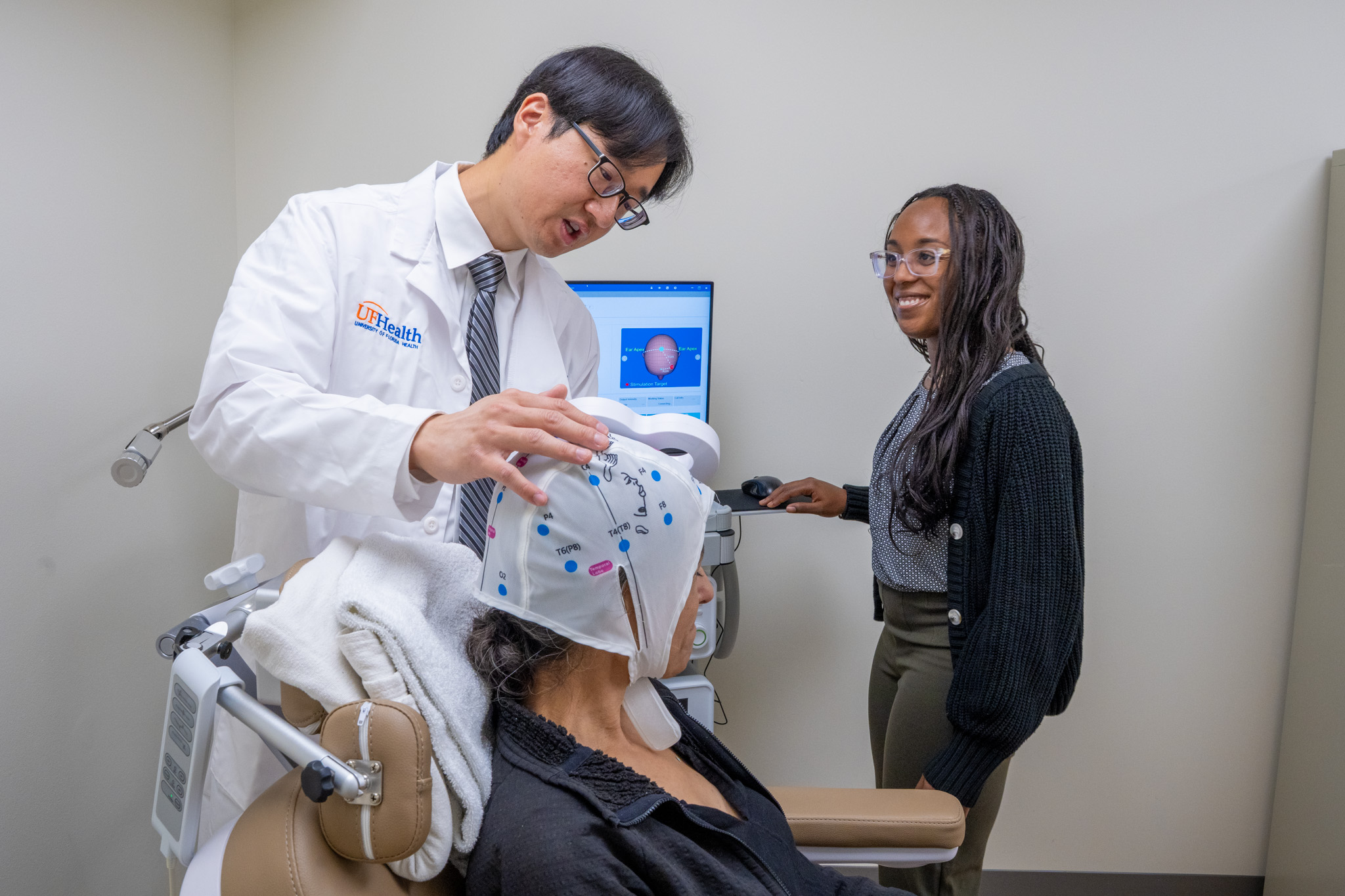
His lab enrolls people who had delirium during a hospital stay. Three months after discharge, each participant receives transcranial magnetic stimulation for 10 days, then returns a month later for cognitive testing. The lab works with a population most studies exclude: people who were acutely ill in the ICU.
Where It Is Heading
TMS is only half of Dr. Jiang's program. The other half is a bedside imaging method that maps brain activity in three dimensions in about 15 minutes, built for patients too sick to leave their rooms. His stated goal is to join the two: image the networks delirium disrupts, then target them precisely with stimulation.
That is the direction TMS research is moving as a whole. Stimulation guided by each patient's own brain, not by a ruler and a landmark.
Read the full profile: MBI Researcher Highlight: Dr. Shixie "Max" Jiang.
The System Behind the Study
Research protocols ask more of a system than routine treatment: repeated daily sessions, exact dosing, and no downtime in the middle of a participant's course. Dr. Jiang's lab runs on a Brain Ultimate TMS M-Series, installed by our engineering team in 2025.
Built for Back-to-Back Sessions
Liquid-cooled coils and true 24/7 operation keep output consistent from the first session of the day to the last.
No Per-Pulse Fees
A study's budget goes to the research, not to pulse counts. Run as many sessions as the protocol calls for.
Direct Support
Installation, training and service come from Brain Ultimate's own team, not a third party.
This is an investigational research study. TMS is FDA Cleared for specific conditions, including major depressive disorder and obsessive-compulsive disorder. Recovery after delirium is not a cleared use, and no results from this study have been published.
Running a Research Program?
We are proud to support work that asks what TMS can do next. Talk to our team about equipping your lab, clinic or hospital.
Contact Our Team